A useful logo design brief does more than list a business name and a favourite colour. It explains the business, the people it wants to reach and the situations in which its identity needs to work. This gives the designer a practical starting point without prescribing the final design.
You do not need a long presentation. A clear page or two can be enough to begin a conversation. Separate confirmed requirements from questions you would like to explore together.
What should a logo design brief include?
A brief usually covers the business, the reason for the project, its audience, brand personality, applications and expected deliverables. Its purpose is to support design decisions and give both sides a shared basis for reviewing proposals.
1. Explain the business and the problem
Describe what you sell or do in plain language. State whether this is a new identity or a redesign. Include the exact spelling of the brand name, any established elements worth keeping and the reason the current identity needs attention.
A concrete observation is more useful than a broad adjective. “The fine details disappear in our social profile image” gives the designer a clearer problem to investigate than “make it more modern.”
2. Describe the audience
Identify the customers you most want to reach and explain what matters to them. Demographics can help, but also consider why they buy, where they encounter the business and what they need to understand before contacting you.
A purchasing manager choosing a fabrication supplier may look for clarity and reliability. A customer buying handmade products may be interested in the maker’s approach. Treat these as starting assumptions to discuss, rather than fixed visual rules.
3. Choose three brand characteristics
Pick three words, such as clear, considered and approachable. Add a sentence explaining each one. Common terms such as “premium” can mean very different things, so show what they mean in your context.
Explain what the brand should avoid as well. Prioritise the most useful characteristics instead of combining a long list of competing qualities.
4. List the actual applications
- Website header and mobile screens
- Social profile pictures and content templates
- Business cards, presentations and proposal documents
- Packaging, labels, signage or vehicle graphics
- Light and dark backgrounds, single-colour print or embroidery
These requirements help plan suitable logo arrangements and files. They do not automatically mean every application is included in the project. Confirm which items belong in the agreed scope.
5. Explain your references
Share a few references with specific reasons: readable lettering, a simple symbol or a balanced palette. Explain examples you dislike in the same way. References should communicate preferences, rather than ask for another brand’s logo to be copied.
Include relevant competitors so the designer can see the existing visual landscape and consider how your business might be distinguished.
6. Agree deliverables and decisions
Discuss the number of design directions, the feedback process and the files to be supplied. Ask which vector files, transparent images, colour specifications or usage guidelines are included. A full identity system and a logo-only project can have different deliverables.
Identify one person who will combine feedback and confirm who gives final approval. If there is a launch or production deadline, share it early. Review proposals against audience needs, legibility and real applications, alongside aesthetic preferences.
A short brief you can copy
- Brand name and exact spelling:
- What do we do, and who do we serve?
- Why do we need this project?
- Our three brand characteristics and their meanings:
- What distinguishes us?
- First applications and essential requirements:
- References and what we like about them:
- Elements to retain or avoid:
- Deliverables, budget range and timing:
- Feedback coordinator and decision maker:
Turn a vague request into useful information
For a fictional workshop, “We need a strong, attractive logo” could become: “We make bespoke metalwork for architects and businesses. The identity will first appear on proposal PDFs, our website and a small social profile. We want it to feel clear and considered; the details in our existing mark are difficult to read at small sizes.”
This defines a useful design problem without deciding what the logo must look like. Missing information can be developed in the first discussion; you do not need to settle every colour or symbol before contacting a designer.
Explore the design services and service and pricing catalogue, or get in touch to discuss the scope of your logo and identity project.
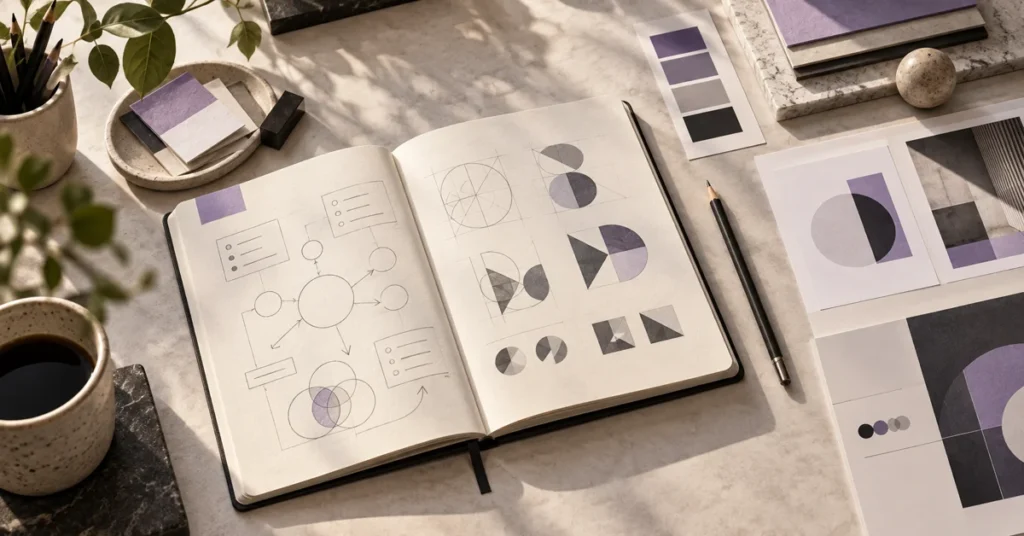
The cover is an illustrative studio scene generated with AI for this guide.